
Quick Play, Big Impact
A Gamified Simulation for Boosting Skills of Frontline Fast-Food Staff
By Susan Carol Ward
When a global fast-food brand approached Socratic Arts with a bold vision—combining our best-in-class learning design with their digital media development firm to design and develop digital training for a significant business process change across thousands of restaurants—we enthusiastically jumped at the chance!
In this effort, our primary focus was on learning design and scripting, while the digital media team led the interaction design and gamification and built the solution. Our two teams, along with our client’s own learning team, closely collaborated to develop a highly engaging, gamified simulation that swiftly upskilled restaurant staff and managers on a new mobile order and pay process to improve order accuracy, efficiency, and boost customer satisfaction.

When the course first launched, it quickly garnered rave reviews. In the first two months, 250,000 frontline restaurant workers completed the digital sim. Restaurant performance data showed that for every 10 team members who completed the training at a single restaurant, two seconds were shaved off from both curbside and table service times. Within a few months, that number increased to three seconds saved. When you scale this impact to 100 frontline staff at a location (saving 30 seconds per order!) and billions of orders across the globe, it adds up! As the number of trained staff increased, other key restaurant performance metrics also improved.
Additionally, in qualitative course evaluations, restaurant staff consistently shared highly positive feedback. Survey results showed significant and measurable behavioral change and impact on ROI!
98% agreed that the training is a valuable use of their time.
99% agreed they gained new knowledge and skills they can apply to their job immediately.
99% agreed the activities helped them to apply insights into their job.
Learning Strategy for Impact
With the fast pace of a restaurant, the team focused on the essential behaviors frontline staff need to enact and the challenges and obstacles they need to overcome for maximum impact.
Performance-improving strategies include:
Learning-by-doing in authentic scenarios: Embedding skills practice in authentic scenarios empowers learners to test ideas and learn from mistakes in a risk-free setting, reinforcing best practices through simulated outcomes. Creating a safe zone for trial and error is critical for triggering expectation failure, a cognitive dissonance that occurs when new information challenges preconceived notions and mental models. Expectation failures help us learn more effectively because, when we care to succeed, we’ll reflect on what went wrong, find an explanation for the mistake, and revise our preconceptions. That is learning. This process doesn’t happen when we simply “learn” facts in isolation.
Gamification: Introducing scoring to the learning experience adds a competitive dynamic, motivating learners to succeed and encouraging repeated play to boost performance and improve their scores.
Motivation: Integrating both intrinsic motivations—mastering procedures for better efficiency and customer service outcomes—and extrinsic ones, such as earning points maximizes the motivation of learners.
Together, these approaches created an experience in which learners could safely hone decision-making and problem-solving skills directly transferable to their jobs with a boost of extra motivation to win the challenge.[1]
How it Works
Simulation Navigation
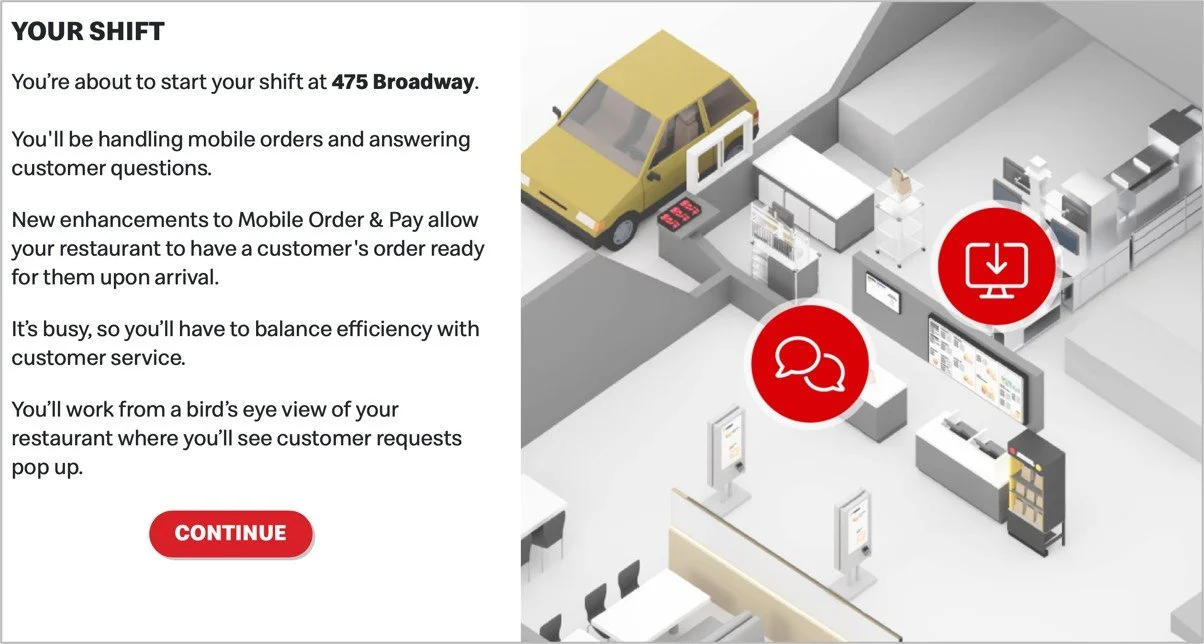
The learning experience features a dynamic game dashboard depicting a bird’s-eye view of a vibrant fast-food restaurant, immersing learners in the bustling environment.
Learners encounter events that pop up “randomly” (like in real life), including simple customer questions, mobile app order fulfillment requests, and complex, branching customer interactions.
Learners choose the order in which they respond to events. Then, as they progress, learners encounter a ramp-up in pressure as they’re faced with less common challenges, equipping them to handle most unexpected scenarios that may arise on the job.
Authentic Challenges
The game addresses around 20 distinct performance objectives (POs) grouped into 13 unique “event scenarios,” highlighting realistic restaurant situations and key aspects of the new mobile order and pay process.
The team struck a balance between depth, complexity of content, and need for simplicity to ensure the game was effective, enjoyable, and fast paced.
We also animated the experience with “movie magic” moments in the tasks staff already knew how to do, so they could focus on new, complex skills. For example, rather than needing to properly fill a bag with orders – when menu items were ready, they animated those items in the bag, so learners could focus on deciding what to do next. The decision point was relevant to the target POs, while filling the bag was not.
Help at their Fingertips
To support learners with varying expertise, the team embedded concise, on-demand "HINT" content—just-in-time learning support that let learners either proceed independently or seek targeted help to "make a reasoned decision" (Neaman, 2003) without disrupting flow. This enabled informed decisions rather than "blind choices" (Jona, 2000; Neaman, 2003).
Additionally, Dynamic Memory Theory (Schank, 1982) suggests the best time to learn is whenever we’re curious. We become curious when we realize there’s something we don’t understand, or we have a misconception. That might happen before taking action or after making a mistake. We also provided help in the form of feedback after learners completed their tasks.
Scoring (Extrinsic Motivation)
During sim-play, learners earn points across three categories:
Process Accuracy: Points for demonstrating mastery of new procedures
Order Accuracy: Points for precise order fulfillment, emphasizing accuracy in a fast-paced environment
Customer Satisfaction: Points for swift, accurate customer service
Every activity within an event scenario contains multiple questions. How the learner answers each question affects their score across various metrics, with some questions being relevant to one or two metrics. Points and feedback display after each scenario.
To complete the game successfully, learners don’t need a perfect score. Instead, they’re rewarded for thoughtfully handling key moments like efficient order processing or customer conversation. . They must achieve an average score of 75%. After each event, learners review their performance and can retry individual events to improve scores without replaying the entire game.
Depicting Natural Consequences (Intrinsic Motivation)
In addition to scoring, the game includes natural consequences of learner choices through the story narrative, connecting both intrinsic and extrinsic motivators.
Incorrect choices during critical junctures in the sim-play affect the learner’s score in negative ways (no new points earned) and affect the experience of the game's simulated customers; learners feel the impact of their decisions in a tangible way. Leaners aim for higher scores (extrinsic motivation) and fulfill their role more effectively, mirroring real-world objectives such as customer satisfaction (intrinsic motivation).
For example, if a learner forgets to include condiments or straws with a curbside order, there’s an immediate visual cue of the customer's dissatisfaction (narrative consequence), and then the oversight sacrifices point-gains in customer satisfaction.
————————————————————————————
In Closing
By combining proven strategies from both the learning sciences and interaction design, the team crafted an award-winning, simulated, hands-on experience that’s authentic and immersive, mirroring Crews’ daily job tasks, and is also challenging and enjoyable. It boosts crew confidence, customer satisfaction, and restaurant performance. The project demonstrated the effectiveness of a gamified simulation in delivering engaging and immersive learning, while driving improvement in key business performance metrics.
Performance-improving Principles and Best Practices:
Experiential Learning is Critical: By leveraging authentic, relevant learning-by-doing (Schank, 1995 and 1997), the game provides hands-on practice in realistic scenarios, enhancing skill transfer to the workplace.
Authenticity in Practice Activities Enhances Relevance: By simulating real-world tasks, the experience ensures learning activities are directly applicable to the job, allowing for meaningful practice.
Supportive Learning Environments Foster Confidence: The inclusion of hints and on-demand performance support helps learners bridge knowledge gaps without frustration, promoting confidence and continuous learning (Schank, 1997).
Learning from Mistakes Encourages Growth: The design allows for authentic error-making without real-world consequences, using expectation failure as a tool for identifying knowledge and skill gaps and adjustment of mental models (Schank, 1982).
A Balance of Extrinsic & Intrinsic Rewards Helps Increase Learner Motivation: Incorporating extrinsic rewards such as scoring, alongside intrinsic motivators like improved performance and perceived customer satisfaction, keeps learners engaged and striving for better outcomes (Lepper and Green, 1979)
Prior Knowledge Can Be Used to Streamline Content: Instead of re-teaching known tasks, the game emphasizes new and complex skills relevant to learners' roles, showing respect for prior knowledge and focusing on practical application.
Building in Natural Consequences Helps Drive Behavior Change: Depicting the impact of learners' choices within the game narrative links actions to real-world outcomes, fostering a deeper understanding of the consequences of missteps and encouraging
[1] For more on why experiential learning improves appropriate memory retrieval, see e.g., Brown, J. S., Collins, A., & Duguid, P. (1989); Schank, R. C. (1999); Kolodner, J. (1993); Gick, M. L., & Holyoak, K. J. (1980).References and Additional Resources
Bransford, J. D., Franks, J. J., Vye, N. J., & Sherwood, R. D. (1989). New approaches to instruction: because wisdom can't be told. In S. Vosniadou & A. Ortony (Eds.), Similarity and Analogical Reasoning (pp. 470 - 497). New York: Cambridge University Press.
Brown, J. S., Collins, A., & Duguid, P. (1989). Situated cognition and the culture of learning. Educational Researcher, 18 (1), 32-42.
Gick, M. L., & Holyoak, K. J. (1980). Analogical problem solving. Cognitive Psychology, 12(3), 306-355.
Jona, K. (2000). Rethinking the design of online courses. In R. Sims, M. O’Reilly, & S. Sawkins (Eds.), Learning to Choose: Choosing to Learn. Proceedings of the 17th Annual ASCILITE Conference. Lismore, NSW: Southern Cross University Press.
Kolodner, J. (1993). Case-Based Reasoning. San Mateo, CA: Morgan Kaufmann Publishers.
Lepper, M. R., & Green, D. (1979). The hidden costs of reward. Morristown, NJ: Lawrence Erlbaum Associates.
Neaman, Adam Piers (2003). A Theory of Computer-Based Educational Simulation Design Based on Observed Design Errors. Doctoral dissertation, Northwestern University.
Needham, D. R., & Begg, I. M. (1991). Problem-oriented training promotes spontaneous analogical transfer. Memory-oriented training promotes memory for training. Memory and Cognition (19), 543-557.
Pintrich, P. R., & Schunk, D. (1996). Motivation in Education: Theory, Research and Application. Columbus, OH: Merrill Prentice-Hall.
Ross, B. H. (1989). Remindings in learning and instruction. In S. a. O. Vosdiadou, Andrew (Ed.), Similarity and Analogical Reasoning (pp. 438 - 469). New York: Cambridge University Press.
Schank, R. C. (1982). Dynamic Memory: A theory of reminding and learning in computers and people. New York: Cambridge University Press.
Schank, R. C. (1995). What We Learn When We Learn by Doing (Technical Report 60). Evanston: Northwestern University, Institute for Learning Sciences.
Schank, R. C. (1997). Virtual Learning: a revolutionary approach to building a highly skilled workforce. New York: McGraw-Hill.
Schank, R. C. (1999). Dynamic Memory Revisited. New York: Cambridge University Press.
